
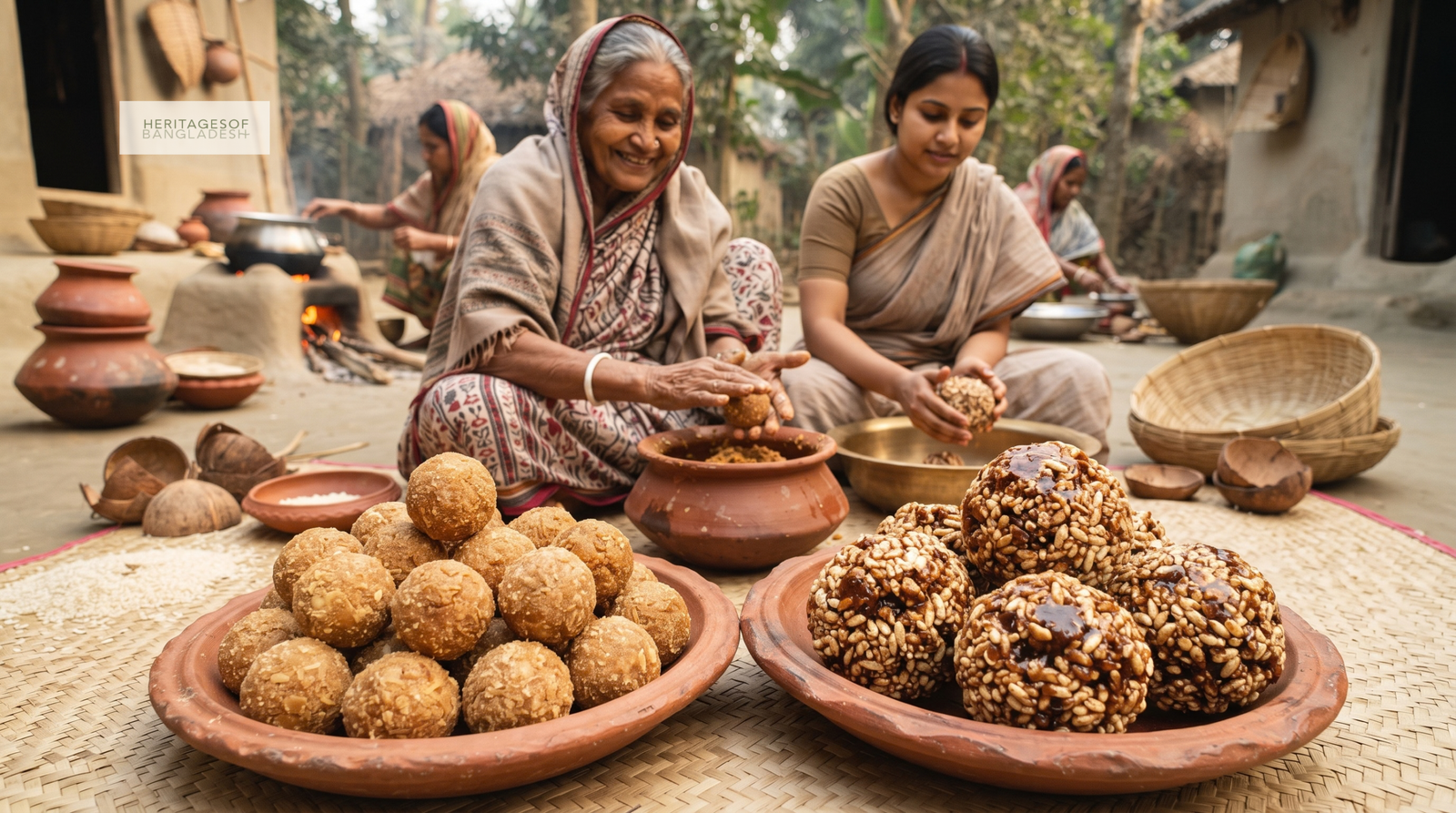
There is an unmistakable sensory memory associated with growing up in a traditional Bengali household. Long before the era of packaged supermarket snacks, commercial chocolate bars, and refined Western pastries, the true markers of celebration, seasonal shift, and affection came straight from the rural hearth. Among these, two rustic sweetmeats hold an eternal place in our cultural fabric: Narkel Naru and Muri-Moa. These are not merely food items; they are edible pieces of history, deeply rooted in the agricultural cycles, riverine lifestyle, and communal warmth of Bangladesh.
The Origins: Sweet Traditions Born from the Soil
The history of Narkel Naru and Muri-Moa dates back centuries, closely intertwined with the cultivation of rice, coconut palms, and sugarcane across the fertile delta of Bengal. Coconuts have a long-standing history in South and Southeast Asia, and in traditional Bengali society, coconut trees graced almost every homestead. Because fresh coconuts yielded rich meat and milk, rural women ingeniously combined grated coconut with jhola gur or akhi gur. Cooked slowly over a wood-fired clay stove until the sugars caramelized, the mixture was hot-rolled by hand into tight, aromatic spheres. Historically, Naru became synonymous with Bijoya Dashami and Lakshmi Puja, serving as a sacred offering and a welcoming gift for guests.
Alongside these coconut spheres, puffed rice produced by hand-roasting rice in hot sand over massive iron pans has been a staple comfort food in Bengal for generations. When winter arrives, bringing with it the prized harvest of fresh date palm jaggery, rural artisans transform light, crunchy muri into giant, sweet globes known as Muri-Moa. Regions like Bikrampur, Tangail, and parts of southern Bangladesh developed legendary reputations for crafting the finest moa, balancing structural crunch with deep, smoky sweetness.
The Art of Preparation: A Labor of Love
Making Naru and Moa is a ceremonial process that requires patience, skill, and communal participation. It is rarely done in isolation; traditionally, mothers, grandmothers, and daughters gather in the courtyard during winter afternoons to craft them. For Narkel Naru, fresh coconut is grated meticulously using a traditional floor-mounted scraper. The grated coconut is combined with jaggery and subjected to the careful art of continuous stirring on low-medium heat until the sugar crystallizes and binds the coconut without burning it. The mixture is then shaped into tight balls while still piping hot, an act that tests the heat-tolerance of the cook’s palms.
For Muri-Moa, the magic lies in preparing the jaggery syrup. The liquid date palm jaggery is boiled until it reaches a sticky consistency, after which crisp, freshly hand-roasted puffed rice is folded in swiftly. Working against time before the syrup hardens, the maker scoops up handfuls, compressing them tightly into large, spherical constellations that shatter with a satisfying crunch upon the first bite.
Cultural Significance: More Than Just Desserts
In the context of Bangladeshi heritage, these sweets act as social lubricants and emotional anchors. In rural Bangladesh, the appearance of Muri-Moa and fresh-batch Naru heralds the arrival of the winter chill and traditional culinary festivals. Sitting on a courtyard wrapped in a shawl while sharing a clay cup of tea and a sweet moa is a quintessential cultural image. In Hindu households, visiting relatives during festive seasons is incomplete without a glass of water and a porcelain jar filled with assorted narus. Similarly, across community lines, winter evenings in villages see neighbors exchanging plates of home-baked and home-churned dry sweets.
Where Can We Find Them Now?
As urbanization reshapes our lifestyles, finding authentic, handmade Narkel Naru and Muri-Moa has shifted from home kitchens to specialized spaces. If you are looking to taste or source these heritage items today, traditional village markets during the winter harvesting months feature local vendors selling massive pyramids of glistening Muri-Moa and jars of golden Narkel Naru, particularly in districts like Munshiganj, Tangail, Jashore, and Satkhira.
Old Dhaka also retains old-world culinary traditions. Areas like Shankhari Bazaar, Tantibazar, and Chawkbazar stock authentic jaggery-based coconut and puffed rice treats during festive periods and throughout the winter months. Furthermore, with a growing resurgence in organic and heritage foods, several urban boutique food enterprises, online platforms, and artisan fair booths frequently source authentic, preservative-free Narkel Naru and winter Moa directly from rural women producers. Despite commercial availability, however, the finest naru remains the one sent by family from the village to their children studying or working in the city, packed carefully inside an old tin biscuit box.
Preserving the Flavor of the Past
Narkel Naru and Muri-Moa remind us that the truest luxury of Bengali culture lies in simplicity—transforming basic elements like rice grains, coconuts, and sugarcane or date juice into treats that bridge generations. As modern life accelerates, documenting and celebrating these culinary crafts ensures that the sweet aroma of caramelized coconut and winter molasses continues to linger in the soul of Bangladesh.