
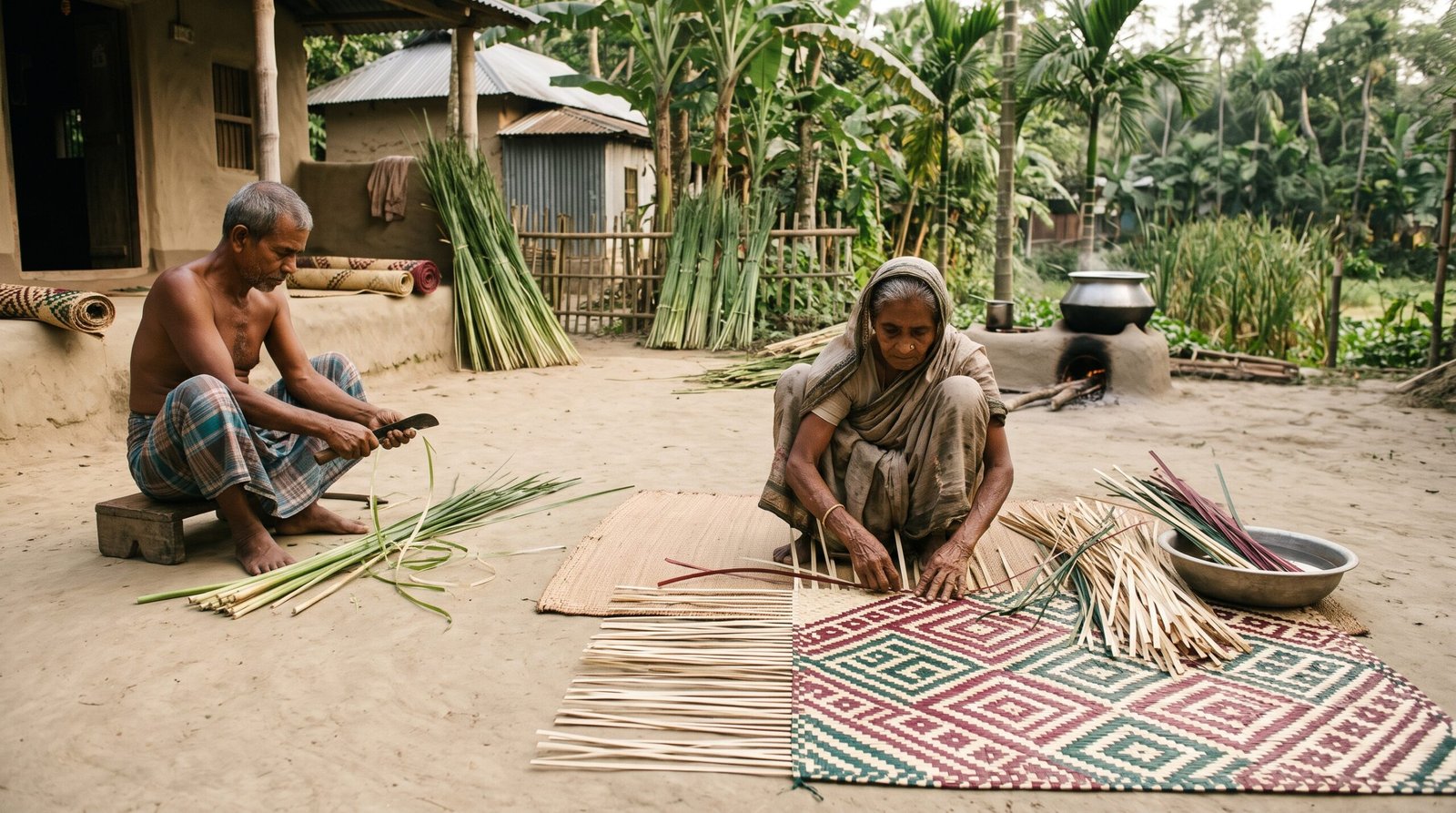
There is an ethereal elegance in the way traditional craftsmanship adapts to the brutal summers of the Bengal delta. Long before electric fans and air conditioning systems dictated how people beat the heat, rural artisans of Sylhet mastered a sophisticated art form designed to keep the body cool and refreshed. Known as Shital Pati—literally translating to “cool mat”—this remarkable handicraft is an intricate legacy of weaving that utilizes the wild reeds of the northeastern wetlands. Recognized globally for its cultural and historical significance, the craft of Shital Pati stands as a proud testament to the ingenuity, patience, and artistic mastery of Sylhet’s rural communities.
The Origins: Rooted in the Wetlands of Sylhet
The history of Shital Pati is deeply tied to the geography of Sylhet, Sunamganj, and Maulvibazar, regions characterized by low-lying wetlands, haors, and flowing rivers. The primary raw material for these mats is a green reed locally known as Murta or Pati Bet (Clinogyne dichotoma), a plant that thrives abundantly in the moist, marshy soil of the northeastern terrain. Centuries ago, local communities discovered that the outer skin of the Murta stem possessed unique thermodynamic properties—it remains cool to the touch even in the scorching heat of tropical summers and absorbs minimal moisture.
Historically, patronized by local landlords, zamindars, and royalty, Shital Pati mats were symbols of status and refined taste. British-era accounts and local lore frequently describe regional elites and nobility using fine-grade pati mats during summer months to lower body temperature naturally. Over generations, what began as a survival adaptation against the humid weather evolved into a distinct folk art form, passed down carefully from parents to children within specialized artisan communities.
The Intricate Art of Preparation and Weaving
Crafting a genuine Shital Pati is an arduous, multi-step process that demands exceptional skill, physical endurance, and artistic vision. The journey begins long before a single strand is woven, starting with the careful harvesting of mature Murta stems from the marshlands during the rainy season or late autumn. Once gathered, the green stalks are soaked in water and split down meticulously into paper-thin strips using small, specialized blades.
The artisan then separates the glossy outer skin of the reed from the inner pith, as only the outer layer yields the characteristic sheen and cooling smoothness. These fine strips are boiled in large earthen pots with natural dyes—traditionally utilizing bark, leaves, and mineral extracts to produce rich hues of deep green, maroon, and golden yellow—though many artisans also preserve the natural ivory-white finish of the sun-dried reed.
The weaving process itself takes place on the floor, where the weaver manipulates dozens of hair-thin strips with bare fingers, interlocking them in complex geometric patterns, diagonal grids, or pictorial motifs. Depending on the intricacy of the design and the fineness of the strips, weaving a single high-quality pati can take anywhere from a couple of weeks to several months. The finest grades of these mats are so soft, flexible, and finely woven that they can be folded like a piece of silk cloth and stored inside a pocket.
Cultural Significance: More Than Just a Summer Mat
In the cultural landscape of Bangladesh, Shital Pati is far more than a functional utility item; it is a profound expression of heritage and hospitality. In traditional Sylheti households, unfolding a pristine Shital Pati in the center of the living room or courtyard is the ultimate gesture of welcoming esteemed guests during warm afternoons. It serves as a communal gathering space where family members sit together to chat, elders rest during afternoon siestas, and children listen to folklore.
The craft is also deeply intertwined with rural livelihoods and female empowerment. For generations, women in the rural villages of Sylhet have been the primary custodians of this tradition, managing the complex splitting, dyeing, and intricate interlocking processes. In December 2017, the traditional art of Shital Pati weaving in Sylhet was inscribed on the UNESCO Representative List of the Intangible Cultural Heritage of Humanity, validating its immense global importance and acknowledging the dedication of the artisans who keep it alive.
Where Can We Find Shital Pati Today?
Despite the pressures of modern, factory-made plastic mats and synthetic cooling alternatives, authentic Shital Pati remains a prized possession and can still be sourced through specific heritage channels. If you are looking to purchase or experience genuine Shital Pati mats today, several traditional and institutional hubs preserve access to the craft.
Rural villages in the Balaganj, Osmaninagar, and Bishwanath upazilas of Sylhet district—as well as specific pockets in Sunamganj—remain the primary manufacturing heartlands. Visiting these artisan clusters offers a firsthand look at families actively splitting reeds and weaving on earthen floors.
In Sylhet city, traditional handicraft shops located around Zindabazar, Bandarbazar, and local artisan cooperative showrooms stock authentic variations of the mats, ranging from simple floor spreads to decorative wall hangings, table runners, and prayer mats.
Furthermore, national handicraft promotional centers such as Aarong and state-sponsored exhibitions by BSIC (Bangladesh Small and Cottage Industries Corporation) frequently showcase certified, high-grade Shital Pati crafted by master weavers from Sylhet, making it accessible to urban art collectors and heritage enthusiasts across Dhaka and beyond.
Preserving a Cooling Legacy
The craft of Shital Pati reminds us of a time when human comfort was delicately balanced with nature, utilizing the sustainable resources of the riverine delta. As modern lifestyles shift toward artificial climate control, supporting and celebrating the master weavers of Sylhet ensures that this exquisite, UNESCO-recognized tradition continues to breathe coolness, elegance, and history into the cultural soul of Bangladesh.